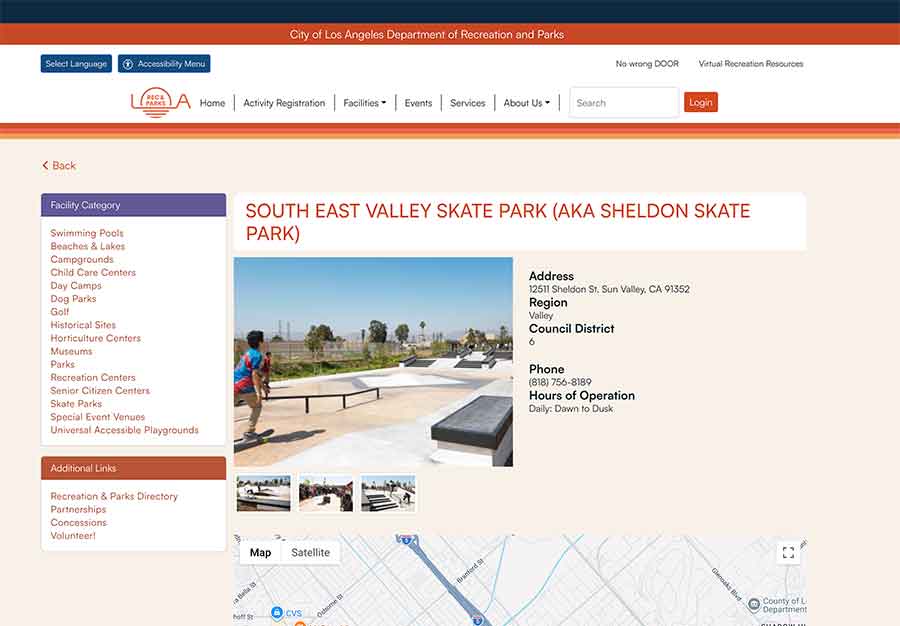
Jose Mier has always believed that one of the best ways to understand Sun Valley is to look at the activities that bring local people together. That’s one reason Sheldon Skate Park, officially known as the South East Valley Skate Park, caught my attention. Located on Sheldon Street in Sun Valley, this public skatepark gives skateboarders a dedicated place to practice, develop their skills, meet other riders, and simply enjoy being outside. The City of Los Angeles Department of Recreation and Parks lists the facility at 12511 Sheldon Street and identifies it as a skate park open daily from dawn to dusk. For people who don’t skateboard, it might look like a collection of concrete ramps and bowls. For skateboarders, however, it is something much more important: a place to ride. And if you’ve ever watched a teenager perform a trick that appears to involve several violations of the laws of physics, you already understand that skateboarders have a different definition of “casual recreation” than I do.
Skateboarding has a fascinating history in Southern California.
The sport emerged from surfing culture and became particularly popular in California during the twentieth century. Early skateboarders essentially looked for a way to surf when there were no waves.
The idea eventually evolved into a sport and culture all its own.
Today, skateboarding includes street skating, park skating, vert skating, freestyle, downhill riding, and competitive disciplines.
That variety is one reason skateparks are important.
They give riders environments designed for particular types of movement.
Why Dedicated Skateparks Matter
A skateboard can technically be used almost anywhere.
That’s part of its appeal.
A sidewalk, empty parking lot, driveway, or plaza can become a place to practice.
But those locations aren’t always safe or appropriate.
A dedicated skatepark provides purpose-built features and a designated environment for skating.
That creates several advantages.
Riders can practice without worrying as much about pedestrians.
They can learn from more experienced skaters.
They can work on tricks repeatedly.
They can develop confidence.
And they can become part of a community.
That’s especially valuable for younger skaters.
A skatepark isn’t simply a place where people perform tricks.
It can function as a social space.
The South East Valley Skate Park
The City of Los Angeles identifies Sheldon Skate Park as the South East Valley Skate Park and lists its address as 12511 Sheldon Street. The facility is operated by the city’s Department of Recreation and Parks.
The City lists daily hours from dawn to dusk.
That schedule is useful because skateboarding isn’t exactly a sport that requires an expensive arena.
A rider can show up with a board and spend time practicing.
The result is a recreational opportunity that is relatively accessible compared with many organized sports.
You don’t necessarily need a coach.
You don’t need a team.
You don’t need a referee.
You need a skateboard, appropriate protective equipment, and a willingness to learn.
Skateboarding Is Harder Than It Looks
I have watched experienced skateboarders and concluded that skateboarding looks deceptively easy.
A skilled rider makes a complicated maneuver appear effortless.
A beginner discovers that the pavement is considerably less forgiving.
The process of learning requires balance, coordination, timing, persistence, and a tolerance for failure.
And there will be failure.
Lots of it.
That is part of the sport.
A skateboarder may attempt a trick dozens of times before landing it.
The ability to keep trying is one of the sport’s greatest lessons.
Skateboarding and Physical Fitness
Skateboarding is also a legitimate form of exercise.
Riding requires constant balance and body control.
Leg muscles provide propulsion and stability.
Core muscles help maintain balance.
Upper-body movement contributes to steering and control.
And cardiovascular activity increases when a rider spends an extended period skating.
Because the sport is enjoyable, people may not think of it as exercise.
That’s often the best kind of exercise.
If someone tells me they are going to spend an hour doing “cardio,” they may not be particularly enthusiastic.
If they say they’re going skateboarding, suddenly the same hour sounds like fun.
Developing Balance and Coordination
One of the most obvious benefits of skating is improved balance.
A skateboard is an unstable platform.
The rider has to make constant adjustments.
Small movements of the feet, ankles, knees, hips, and upper body all affect the board.
Over time, riders become better at controlling those movements.
That can contribute to general athletic ability.
Balance and coordination are useful in countless other sports and activities.
Skateboarding as a Creative Activity
Skateboarding isn’t only athletic.
It’s creative.
Two riders can approach the same skatepark feature differently.
One might focus on speed.
Another might focus on technical tricks.
Another may experiment with combinations.
The sport therefore encourages individual style.
That creativity is part of skateboarding culture.
A rider isn’t necessarily trying to copy someone else forever.
The goal may eventually become developing a personal style.
The Community Aspect
Perhaps the most important part of Sheldon Skate Park is the community it helps create.
Skateparks bring together people who share an interest in skating.
Beginners can watch experienced riders.
Experienced skaters can offer advice.
Friends can meet for sessions.
Competitions and events can bring larger groups together.
The result is a social environment built around a shared activity.
This is especially important for young people.
A teenager who becomes involved in a positive recreational community has an opportunity to build friendships and develop skills outside school.
Skateboarding and Patience
If there’s one thing skateboarding teaches particularly well, it’s patience.
You can want to land a trick as badly as humanly possible.
That doesn’t mean your body has received the memo.
The trick may take weeks or months to master.
The process teaches riders that improvement comes from repetition.
That’s a useful lesson far beyond skateboarding.
Learning an instrument works the same way.
So does learning a language.
So does cooking.
So does business.
Unfortunately, I have discovered that wanting to become an expert at something immediately remains a poor substitute for practice.
Safety Matters
Skateboarding also comes with obvious risks.
A dedicated skatepark doesn’t eliminate those risks.
Riders can fall.
Boards can shoot away.
Collisions can happen.
That makes safety equipment and responsible riding important.
Helmets are especially important for younger riders, and appropriate pads can provide additional protection.
Beginners should learn at a level appropriate to their experience rather than immediately attempting the most difficult feature in the park.
There is nothing wrong with watching someone else do something impressive and deciding that perhaps today is not the day to imitate it.
That is called wisdom.
Or, in my case, age.
Skateparks and Urban Recreation
Skateparks represent an interesting aspect of modern urban planning.
Cities need recreational facilities for people with different interests.
Traditional parks often focus on fields, playgrounds, picnic areas, walking paths, and courts.
Skateparks provide another option.
They give young people a facility specifically designed around an activity that might otherwise be difficult to accommodate.
That can make recreation departments more responsive to different segments of the community.
The Role of Public Recreation
The City of Los Angeles operates numerous recreation facilities throughout the city, and skateparks are part of that larger public recreation system.
Sheldon Skate Park is therefore part of a broader philosophy: recreational opportunities should be available within the communities where people live.
That matters in a huge city like Los Angeles.
Not everyone can drive across town to participate in a recreational activity.
A local facility can make the difference between participating and staying home.
Skateboarding and Sun Valley
For Sun Valley, Sheldon Skate Park adds another dimension to the neighborhood’s recreational offerings.
Sun Valley is often associated with industry, transportation, residential neighborhoods, and commercial activity.
But recreational facilities show another side.
They reveal how people spend their free time.
They show where young residents gather.
They provide opportunities for physical activity.
And they help create community identity.
What Parents Should Know
Parents who have children interested in skateboarding should consider the importance of instruction and supervision, particularly for beginners.
Skateboarding has a learning curve.
A child may start with simple pushing and balance exercises and gradually move toward ramps, bowls, and tricks.
Good habits established early can help.
That includes wearing appropriate safety equipment, respecting other riders, understanding park etiquette, and recognizing personal limitations.
One of the best things parents can do is encourage progress without turning every session into a competition.
Not every child needs to become the next professional skateboarder.
Sometimes the goal is simply to have fun.
Skateboarding as a Lifelong Activity
Although skateboarding is often associated with teenagers, adults can and do participate.
People who learned to skate decades ago sometimes return to the sport.
Others take it up later in life.
The activity can be adapted to different skill levels.
That said, my personal recommendation for middle-aged beginners is to start conservatively.
The skateboard doesn’t know your age.
The concrete doesn’t care about your retirement plan.
And gravity remains undefeated.
More Than Concrete
A skatepark can look simple.
Concrete.
Ramps.
Rails.
Open space.
But its value isn’t really in those physical objects.
It’s in what happens there.
People learn.
They practice.
They fail.
They improve.
They meet friends.
They encourage each other.
They compete.
They develop confidence.
They become part of a community.
That is what public recreation is supposed to accomplish.
Final Thoughts
Sheldon Skate Park is a distinctive recreational asset in Sun Valley and a reminder that the community offers opportunities for a wide variety of interests. Officially called the South East Valley Skate Park, the facility is located at 12511 Sheldon Street and is operated by the Los Angeles Department of Recreation and Parks. The City lists it as open daily from dawn to dusk.
For skateboarders, it provides a dedicated environment for practicing and developing skills. For the broader community, it represents the importance of providing recreational facilities that appeal to different generations and interests.
If you’d like current official information about the facility, visit the City of Los Angeles Sheldon Skate Park page.
As I look around Sun Valley, I find places like Sheldon Skate Park particularly encouraging. A community isn’t defined solely by its businesses or buildings. It’s also defined by where people gather, play, exercise, and develop friendships.
And sometimes, apparently, by how many times somebody can successfully launch themselves into the air while standing on four pieces of polyurethane.
I’ll leave that part to the experts.